








Written by Ray PÃrez y Soto
Ya no me cantes cigarra
Que acabe tu sonsonete
Que tu canto aqu
à en el alma
Como un puñal se me mete
Sabiendo que cuando cantas
Pregonado vas tu muerte.
Marinero marinero
Dime si es verdad que sabas
Porque distinguir no puedo
Si en el fondo de los mares
Hay otro color m
ás negro
Que el color de mis pesares.
Un palomito al volar
Que llevaba el pecho herido
Ya casi para llorar
Me dijo muy afligido.
Ya me canso de buscar
Un amor correspondido.
Bajo la sombra de un árbol
Y al comp
ás de mi guitarra
Canto alegre este huapango
Porque la vida se acaba
Y quiero morir cantando
Como muere la cigarra.
This huapango was written by
Ray Perez y Soto. It was recorded in the
1940's by Jorge Negrete when he sang with
the Trio Calaveras, and more recently by
Lola Beltran, who is, in my opinion, the
greatest voice to ever come out of Mexico.
The image of the wounded dove in the third
verse is a popular symbol; it is a
messenger of afflicted love. L.R.
The Cicada
Don't sing to me anymore, cicada
Let your singsong end
For your song, here in the soul
Stabs me like a dagger
Knowing that when you sing
You are proclaiming that you are
going to your death
Sailor, sailor
Tell me if it is true that you know
Because I cannot distinguish
If in the depth of the seas
There is another color blacker
Than the color of my sorrows.
A little dove upon flying
Bearing a wounded breast
Was about to cry
And told me very afflicted
I'm tired of searching for
A mutual love.
Under the shade of a tree
And to the beat of my guitar
I sing this "huapango" happily
Because my life is ending
And I want to die singing
Like the cicada dies.
1958 Promotura Hispana Americana de Música S.A.
Copyright renewed, all rights controlled by
Peer International
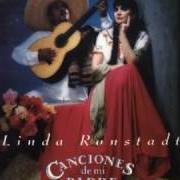
Linda Maria Ronstadt (Tucson, 15 juillet 1946) est une chanteuse, compositrice et actrice américaine. Considérée comme l'une des plus grandes voix du XXe siècle, elle a vendu plus de 100 millions d'albums dans le monde entier. Elle a commencé sa carrière dans les années 1960 avec un groupe de folk-rock appelé The Stone Poneys, obtenant du succès avec des chansons comme "Different Drum". Tout au long des années 1970 et 1980, elle s'est établie en tant qu'artiste solo, explorant divers genres musicaux tels que le country, le pop, l'opéra et le mariachi. Parmi ses albums les plus importants figurent "Heart Like a Wheel", "Living in the USA" et "Canciones de Mi Padre". Ronstadt a remporté dix Grammy Awards et un Emmy Award pour sa carrière musicale et théâtrale. En 2013, elle a été touchée par une maladie neurodégénérative qui l'a obligée à prendre sa retraite des scènes.

 Arsonists Get All The Girls
 Tobin Sprout
 Reflexion
 Lita
 Laura Stevenson
 Karmin
 Head Automatica
 Farewell
 Tarsha Vega
 Darryl Worley
 Grip Inc.
 Sacha Sacket